Oscar Predictions: By Design

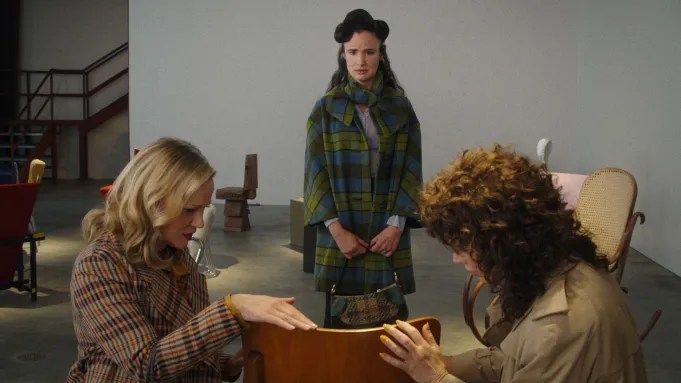
By Design from writer/director Amanda Kramer is likely to forever be known as the “Juliette Lewis is a chair” movie. The far out concept is exactly as it sounds apparently as her lead character makes that life altering decision. Mamoudou Athie, Melanie Griffith, Robin Tunney, Samantha Mathis, Udo Kier, Clifton Collins Jr., and Betty Buckley are among the supporting cast.

Premiering at Sundance, some critics are praising Lewis’s performance while reaction to the pic itself is more mixed (it has 75% on Rotten Tomatoes). In 1991, Lewis landed a Supporting Actress nod for her breakout role in Martin Scorsese’s Cape Fear remake. She hasn’t really been in the mix since and I doubt By Design will get her a seat at the awards table. My Oscar Prediction posts will continue…

The Disaster Artist Movie Review

The Disaster Artist begins with filmmakers J.J. Abrams and Kevin Smith and actors Adam Scott, Danny McBride, and Kristen Bell extolling the strange virtues of The Room. That terrible movie became one of the most unlikely cult hits of the 21st century. The rest of the picture details its strange maker Tommy Wiseau (James Franco) and the process to bring it to a midnight theater showing near you.

Just as The Room was Wiseau’s warped vision all his own, this is clearly a passion project for Franco. I suspect many of the other well-known actors who turn up in parts large and small are devotees of the unintentionally hilarious 2003 film that Franco is recounting. Like Tim Burton’s Ed Wood, this is a good movie about a bad director. Not as good, but it’s an entertaining watch that doesn’t probe too far into its subject’s real story. Truth be told, maybe we don’t really wanna know.

Tommy Wiseau wouldn’t want it any other way. We first meet him in San Francisco circa 1998 as he pours his heart into Marlon Brando’s monologue from A Streetcar Named Desire at an acting class. His rendering is quite awful, but it’s his devil-may-care attitude and blind commitment that gets the attention of Greg (Dave Franco). He’s a fellow student who’s more reserved. Tommy is too, but in a much different way. His age is a mystery and he’s not about to tell it. A European accent (where in that continent… who knows?) counters his contention that he hails from New Orleans. Most interestingly, Tommy seems to have a limitless supply of money and no one knows why.

His new pal Greg manages to ignore those puzzling personal aspects and they road trip it to L.A. to move in together and pursue their dreams. Although he seems to have some prospects, Greg can’t catch a break. Tommy’s overall bizarre vibe is an immediate red X to casting agents. The only solution is to finance his own feature.

And The Room is birthed throughout a long shooting process with a director who has no clue what he’s really doing. We see Wiseau torment his cast and crew because he read somewhere that’s how Alfred Hitchcock did it. Those who know The Room will revel in revisiting Wiseau (who casts himself as the romantic lead) and his humorously questionable line readings. There’s his screenplay that inexplicably brings up cancer subplots that go nowhere and sex scenes that would be deemed too horrible for 2am Cinemax play.

Franco, who also serves behind the camera, is obviously enamored with getting his portrayal of Tommy’s mannerisms and his journey to make this project as accurate as possible. Even if you’re not familiar with Wiseau’s cinematic opus, one YouTube viewing of an interview with him and you’ll know Franco nails it. The star/director, in addition to casting his brother, finds roles for Dave’s real life wife Alison Brie and his frequent costar Seth Rogen as a perpetually bemused script supervisor. Yet just as the real Tommy made his personal relationships and the shooting experience all about him, so is the case with The Disaster Artist.

That devotion from Franco is enough to make this a worthwhile experience. If you’re looking for any insight into what really made Tommy who he is, you won’t find it here. The ultimate irony is that Wiseau did end up succeeding in a town where that’s nearly an impossible feat. He didn’t know that the earnest drama he thought he was making would result in Rocky Horror Picture Show style late night screening madness. What kind of man could achieve this? We may never know, but it’s a fun question for Franco and others to ponder.

*** (out of four)

Oscar Watch: The Disaster Artist

Back in March, The Disaster Artist premiered at the South by Southwest festival and it will soon screen at the Toronto Film Festival. The pic comes from James Franco, who directs, produces, and stars. Disaster is the story of the making of The Room, a low budget 2003 experience that is considered among the worst movies of all time. Mr. Franco plays its director and lead actor Tommy Wiseau. The supporting cast includes Seth Rogen, Josh Hutcherson, Zac Efron, Sharon Stone, Melanie Griffith, and Jacki Weaver.

Very positive reviews followed its Southwest bow and it currently stands at 92% on Rotten Tomatoes. Critics have indicated this is Franco’s finest performance since 2010’s 127 Hours, in which he received an Oscar nomination. Could he do so here? I would venture to say that a Franco nod for Best Actor is probably the picture’s best chance at recognition. While Disaster has been compared to 1994’s Tim Burton pic Ed Wood (high praise), it’s worth noting that Wood wasn’t nominated for Best Picture.

The Disaster Artist opens wide in December and my Oscar Watch posts will continue…

The Bonfire of the Vanities Movie Review

For over a quarter century, I’ve known Brian De Palma’s The Bonfire of the Vanities only by its reputation. Its very, very bad reputation. The picture belongs in a category along with Heaven’s Gate, Ishtar, Last Action Hero, Waterworld and others as The Giant Hollywood Bomb. Some (Gate, Waterworld) have gained a better reputation as time has gone on. Bonfire, on the other hand, is barely discussed at all.

I recently had the pleasure of viewing the documentary De Palma, which is a serious treat for movie lovers. In it, the director basically talks for two hours about every one of his features in order. Some are classics or near classics (Carrie, Dressed to Kill, Blow Out, Scarface, The Untouchables, Carlito’s Way). Some are not (Snake Eyes anyone?). Others received mixed reviews upon initial reaction such as Casualties of War. There’s mainstream hits like Mission: Impossible and mainstream flops like Mission to Mars. Curiosities like Raising Cain and Wise Guys.

Then there’s this. Based upon a celebrated novel by Tom Wolfe, a bulk of the Bonfire criticism came from its significant departures from its source material. Having never read it, I had the benefit of not having to compare it. Unfortunately, it didn’t help much.

After watching this for the first time, it’s easy to get why this was ballyhooed in 1990 as a misguided and miscast effort. The other thing about famous flops is that years later, it’s kind of cool for cinephiles to say it was actually pretty good. For the purposes of this post, I’m not cool.

The star power is significant. Tom Hanks is Sherman McCoy, a yuppie NYC bond trader with a socialite wife (Kim Cattrall) and a southern belle mistress named Maria (Melanie Griffith). One night out with his girlfriend, they take a wrong turn into the Bronx where Maria accidentally hits a young black male and puts him into a coma. They leave the scene but the story doesn’t end there. An intersection of political ambition, religious leader ambition, and journalistic ambition land Sherman in a world of hurt. Chronicling it all is reporter Peter Fallow, played by Bruce Willis with all of his smarm and none of his charm.

Bonfire wants so badly to be an indictment of 1980s greed and shallowness. However, it goes so far in the direction of farce that you can’t take those overtones seriously for one second. By the time a virtuous judge (Morgan Freeman, getting to demonstrate his heavenly voice in one monologue) lectures all the characters on their indecency, we already feel that the message has been browbeaten into us.

One of the biggest complaints of the book to pic adaptation was the softening of the Sherman character into a sympathetic figure (he apparently wasn’t much of one in Wolfe’s writing). While I can’t speak to that, I can only say that Hanks at least has somewhat of a character to work with instead of the caricatures he’s onscreen with. That includes Griffith’s annoying seductress and Cattrall’s nails on chalkboard work as his ultra privileged wife. It includes F. Murray Abraham, yelling his way through the role of the district attorney who wants to be Mayor and John Hancock as a sleazy and media hungry pastor.

Bonfire is an ugly film about mostly ugly people that goes for laughs in an over the top way that isn’t pretty. It was badly received in 1990 and hasn’t aged well due to some racial aspects that couldn’t fly today.

Now… having said all that, I’m glad I finally witnessed what all the mostly forgotten fuss was about. And even in this quite disappointing experience, there are De Palma touches to be appreciated including a fabulous continuous opening shot of Willis entering a party in his honor. Of all the bombs in Hollywood lore, I bet it has the most entertaining and technically impressive first five minutes of them all. Sadly, there’s still two hours that follows after that and most of it solidifies the fire that greeted it.

*1/2 (out of four)